The Anxiety Loop: Why Your Brain Keeps Feeding the Fear (And How to Break the Cycle)
- Georgia Parker
- Feb 11
- 3 min read

Updated: May 19
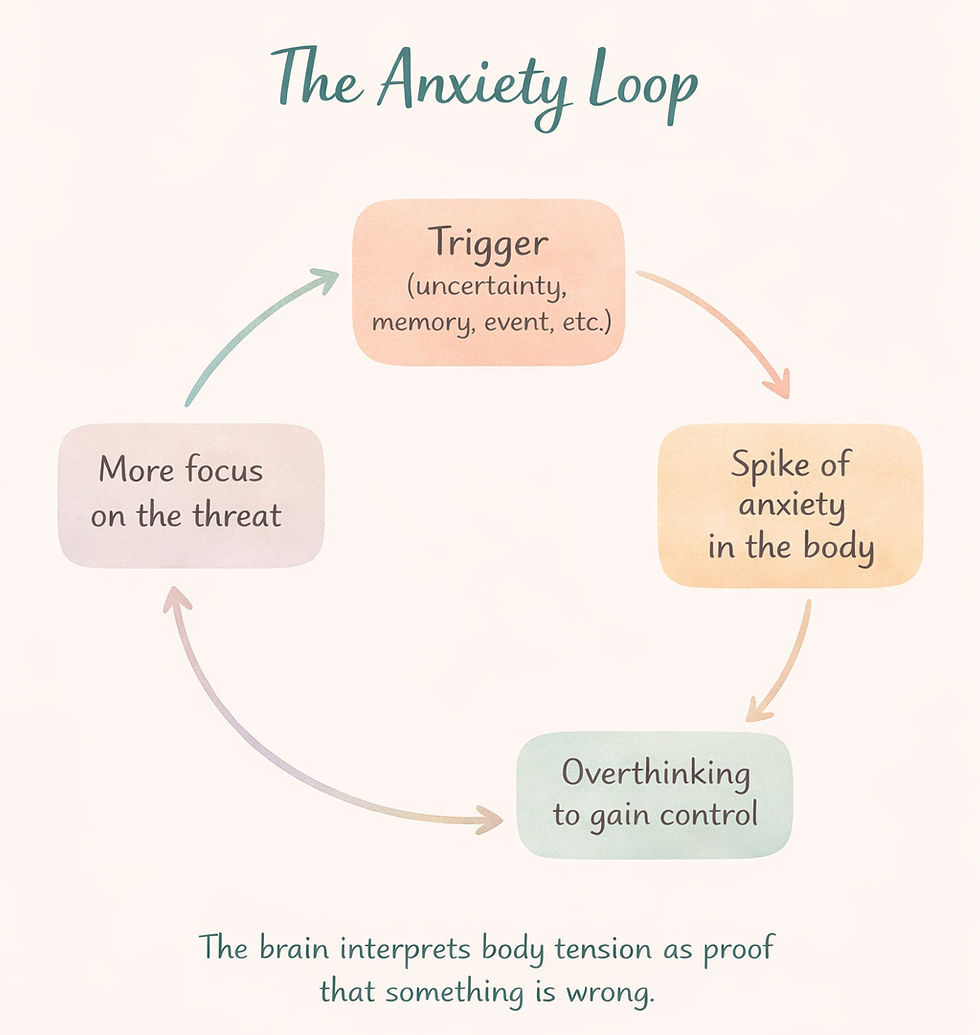
If you’ve ever thought,“Why can’t I just stop overthinking this?” or “Why does my anxiety keep coming back?” You’re likely caught in what I call the anxiety loop. An anxiety loop can feel like your brain is working against you. The more you try to calm down, the louder your thoughts become. The more you try to “figure it out,” the more anxious you feel. It’s exhausting.And it’s not a personal failure. Your nervous system is trying to protect you.
What Is the Anxiety Loop?
The anxiety loop is a cycle between your thoughts and your nervous system. It often looks like this:
A trigger (a message, uncertainty, a memory, an upcoming event).
A spike of anxiety in the body.
Rapid overthinking to try and gain control.
More focus on the threat.
Ongoing nervous system activation.
The brain then interprets that activation as proof that something is wrong. And the loop continues. This is how anxiety spirals develop. Not because you’re weak, but because your brain is wired with a negativity bias. It scans for potential threats far more easily than it scans for safety.
From an evolutionary perspective, this kept us alive. But in modern life, uncertainty, social stress, or imagined future outcomes can trigger the same alarm system. To your nervous system, uncertainty can feel like danger.
Why Overthinking Makes Anxiety Worse
When your nervous system is activated, you’re not operating from calm, rational thinking. You’re operating from survival mode. In this state:
Your breathing may become shallow
Your body feels tense
Your thoughts speed up
Your attention narrows toward what feels wrong
Trying to “think positive” or reason your way out of anxiety from here often doesn’t work. Not because you’re incapable. But because your body doesn’t feel safe yet. Anxiety isn’t just a thinking problem.It’s a nervous system regulation issue. Until the body settles, the mind will keep searching for answers.
How the Anxiety Cycle Becomes a Pattern
Over time, repeated anxiety loops can turn into familiar beliefs:
“Something bad is going to happen.”
“I can’t cope.”
“I need to fix this right now.”
“I should be able to control my thoughts.”
But these beliefs didn’t appear randomly. They developed from a nervous system that learned to stay alert. Your brain thinks it’s helping.
How to Break the Anxiety Loop
You don’t break the anxiety cycle by arguing with your thoughts. You break it by helping your nervous system feel safe.
When the body begins to regulate:
Breathing deepens
Muscles soften
Thoughts slow
Perspective widens
This is why approaches that focus on anxiety regulation rather than just cognitive reframing can be so effective. In EFT (Emotional Freedom Techniques), we gently acknowledge what’s present while calming the nervous system. We don’t force positivity. We don’t override emotion. We allow the body to settle first.
When the body feels safer, the mind often follows. That’s when the anxiety loop begins to weaken.
If you’re stuck in anxiety spirals or constant overthinking, it doesn’t mean you’re failing at coping.
It means your nervous system has learned to stay on high alert. The goal isn’t to silence anxiety completely, it’s to help your system feel safe enough to stand down. And that’s something that can be supported, gently and safely.
If you’re curious about using EFT for anxiety or breaking the anxiety loop, I offer a free 20-minute consultation to explore whether this approach feels right for you. You don’t have to keep managing it alone.


Comments